
Math Happens
May 09, 2025
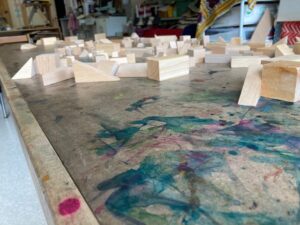
Once everyone had circled up on the floor, Math began when Cambridge Friends School Early Childhood teacher, Beth Boelter-Dimock, briefly reviewed parts of the whole as in folding a paper circle in half, and then again, and then again. “You’d done this,” she’d reminded the children. Gigantic cookies and pizza were mentioned. And an anticipatory “three-dimensional.” “1/8” was written on the whiteboard. When this concise fractions-instruction ended, Math happened while standing around a just-the-right-height for-a-four-or-five-year-old table. For on it lay a variety of small, unpainted wood, three-dimensional shapes to touch, manipulate, count the sides of, and match with their two-dimensional counterparts. The third and last activity, just before Snack, offered a delightful way to practice addition. On a second table waited worksheets, pencils, and one pair of dice per child. Seated around that table, the hum of engaged and curious children filling that classroom, each child recorded the sum of both tossed dice, each sum in its own column. So while tossing dice and penciling Arabic numbers, those young children practiced a little eye-hand coordination and small-motor skills, too.
“I won,” one excited student crowed after her sevens column had been filled, top to bottom.
“You feel like you won?” Beth gently suggested, her voice rising ever so slightly at the end of her sentence so as to offer this young scholar a slightly different interpretation of what had just happened: “You’ve experienced joy at this successful completion and that elation feels a little like winning,” she might had explained had she been talking to another adult. “Lots of teachers use competition as a motivator,” Beth would later note. “But often that gets more difficult to navigate as time goes on.”
Those delightful and age-appropriate shapes were developed by TERC (Technical Education Research Centers). Pre-kindergarten through eighth grade, TERC curriculum and materials are foundational to CFS’s Math and Science classes. “We are dedicated to innovation and creative problem solving. We believe that STEM moves the world forward. And we exist to move STEM learning forward,” TERC’s website declares. No doubt, then, that Arthur H. Nelson, the founder of TERC in 1965 and who died in 2015, would have heartily approved of Beth’s skillful suggestion.
Innovator, entrepreneur, a pioneer regarding technology in the classroom, Nelson is considered one of the major shakers and movers of what is known as the innovation economy. Where winning isn’t everything. Where innovation happens in a spirit of collaboration, team-building, community-building, collective problem-solving. Or, as Beth would put it: “This is my job!”